
Key Takeaways
- Humans have 8 premolars
- Located between canines and molars
- Used for crushing and grinding food
- Children do not have premolars
- They appear between ages 10–12
If you’ve ever wondered what happens between tearing food with your canines and grinding it with your molars, the answer lies in your premolars.
These teeth don’t get as much attention—but they quietly handle a critical part of chewing.
So let’s answer the question clearly:
How many premolars do we have?
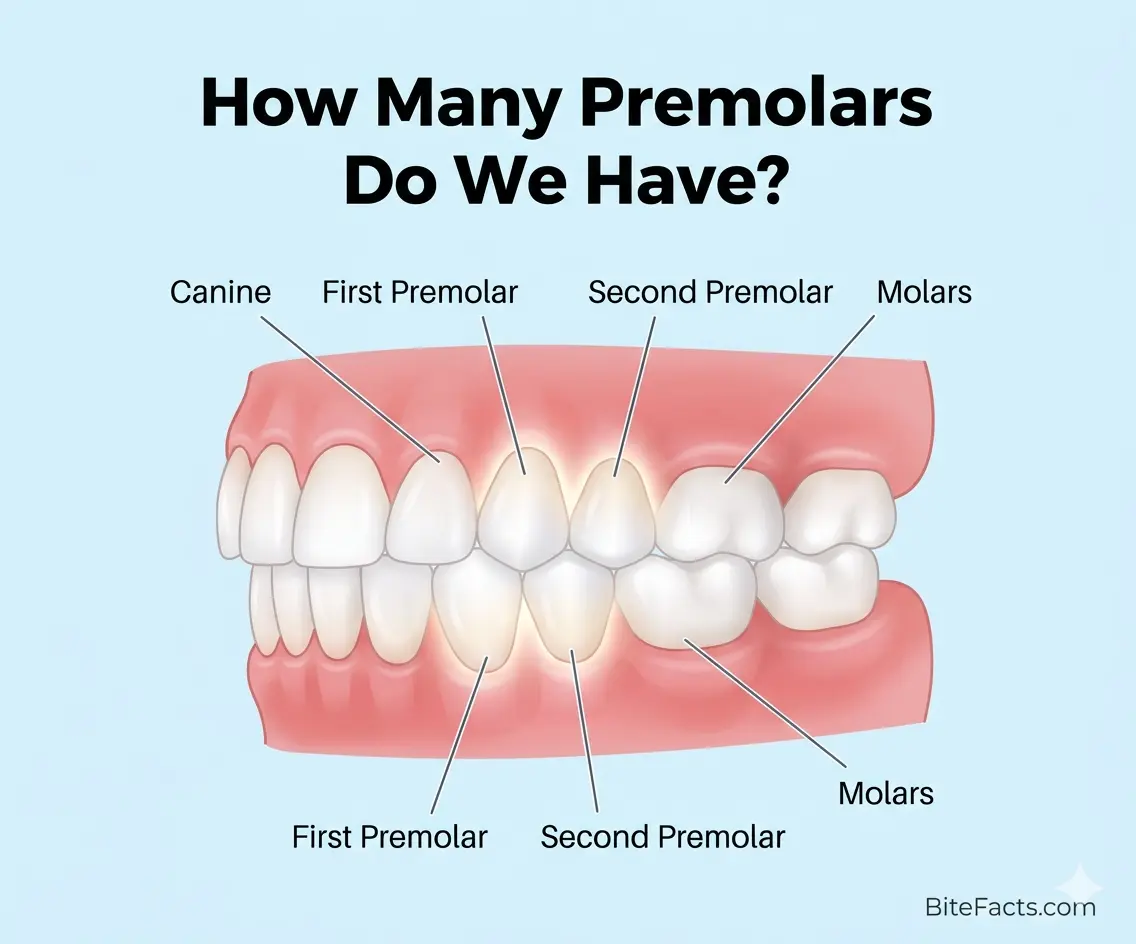
Humans have 8 premolars—4 in the upper jaw and 4 in the lower jaw. These teeth help crush and grind food during chewing.
Each side of your mouth contains:
- 2 premolars (first and second premolar)
Want to understand all types of human teeth? Read our guide on how many teeth humans have.
What Are Premolars?
Premolars, also called bicuspids, sit between your canines and molars.
Think of them as the transition teeth.
Their job is to:
- Crush food
- Begin the grinding process
- Support smooth chewing
They combine features of both:
- Canines (sharp edges)
- Molars (flat surfaces)
Types of Premolars
There are two types on each side:
1. First Premolars
- Located next to canines
- Slightly sharper
- Help tear and crush
2. Second Premolars
- Located closer to molars
- Flatter surface
- Focus more on grinding
| Premolar Type | Location | Function |
|---|---|---|
| First Premolar | Next to canine | Tearing + crushing |
| Second Premolar | Before molars | Crushing + grinding |
Do Children Have Premolars?
No—children do not have premolars.
Instead, they have baby molars, which later get replaced by premolars.
This is an important fact many people misunderstand.
When Do Premolars Come In?
Premolars usually appear between ages 10–12.
They replace:
- Primary (baby) molars
Timeline:
- Age 10–11 → First premolars erupt
- Age 11–12 → Second premolars erupt
🕒 Premolar Development Timeline
- Age 10–11: First premolars appear
- Age 11–12: Second premolars erupt
- Before this: Baby molars are present instead
Why Premolars Are Important
Premolars play a support role, but it’s essential.
1. Efficient Chewing
They break food into smaller pieces before molars take over.
2. Bite Balance
They help distribute chewing force evenly.
3. Smooth Transition
They connect tearing (canines) and grinding (molars).
Common Problems With Premolars
1. Tooth Decay
Grooves in premolars can trap food.
2. Extraction (Orthodontics)
Dentists sometimes remove premolars to fix crowding.
3. Wear Over Time
Constant chewing can wear down surfaces.
According to the CDC, cavities are extremely common—especially in chewing teeth like premolars and molars.
How to Take Care of Premolars
- Brush properly (especially middle teeth)
- Floss daily
- Use fluoride toothpaste
- Visit your dentist regularly
Related guides:
Premolars vs Other Teeth
| Tooth Type | Function | Number |
|---|---|---|
| Incisors | Cutting | 8 |
| Canines | Tearing | 4 |
| Premolars | Crushing | 8 |
| Molars | Grinding | 12 |
Final Thoughts
Premolars may not be the stars of your smile, but they do essential work every time you eat. They bridge the gap between tearing and grinding, making chewing smooth and efficient.
Without them, your molars would have to work much harder—and your digestion wouldn’t be as effective.
Take care of your premolars—they’re the quiet middle players that keep everything running smoothly.
Sources
- American Dental Association (ADA)
- Centers for Disease Control and Prevention (CDC)
- National Institute of Dental and Craniofacial Research (NIDCR)